The Dark Pictures Anthology - Little Hope
Some of my work on The Dark Pictures Anthology - Little Hope. A terrific project to work on with a great team! My role on the project was Art Director and this post is a collection of some of my favourite moments from the game, featuring some look dev and some final game scenes. Thanks for looking!

A scene featuring Andrew from the level 'Ghost'

Some look dev and lighting tests with Andrew. I tried to use these lighting studies to set up a 'lighting identity' for each character and art direct the look we'd go for in terms of cinematography in the scenes.

Another Lighting study. This one ended up being used as part of the box art for the game.

An interesting aspect of Little Hope is that the main characters had doppelgangers from three time periods. This is the present day Angela character...

...and her 1970's counterpart Anne.

We tried to get a dreary, dimly lit feel to Anne's first scene, to match the situation the family is experiencing.


We often used strong rim lights to separate the characters from the foggy backgrounds.
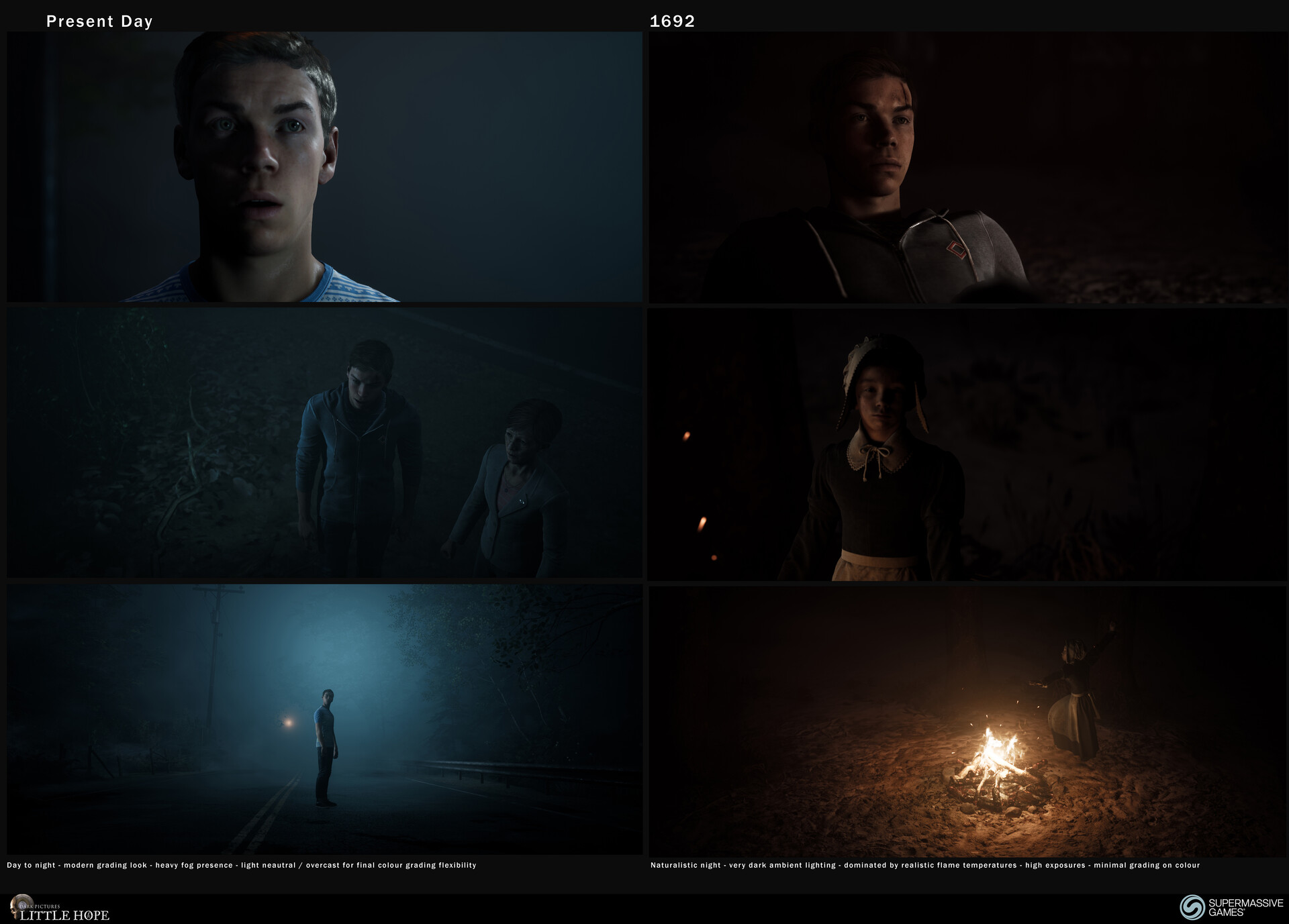
Each time period in Little Hope had a distinct grading identity and lighting treatment, with the aim of creating transitions that would give the player contrast as they went from one to the other.

A big aspect of the look dev was figuring out to depict the foggy night scenes. In a 'natural night' lighting set up, fog would be visible only around light sources such as street lamps and car headlights, but we wanted a bigger, more present fog...

...so we chose to use a 'day to night' approach to the lighting. Lighting the scenes as daylight and grading to look like night. A technique borrowed from cinema that worked great for this.

The natural daylight lit up the fog in unreal more fully, giving it much more presence and volume.

The interior scenes in Little Hope featured a nice abandoned quality which the env art team did a great job with.

A scene between Andrew and John in the spook abandoned museum.

Taylor and Daniel in the Bar scene near the beginning of the game.

Another shot from the Bar. The change in colour palette from the fog outside was used to create a dingy / eerie atmosphere.

In the daylight 1600's scenes we looked at filmic lighting in period drama for inspiration. Making use of high exposure interiors and cool natural light was a good fit tonally in these scenes.

Toward the end of the game the characters return to the ruined / burned house seen in the opening scenes.